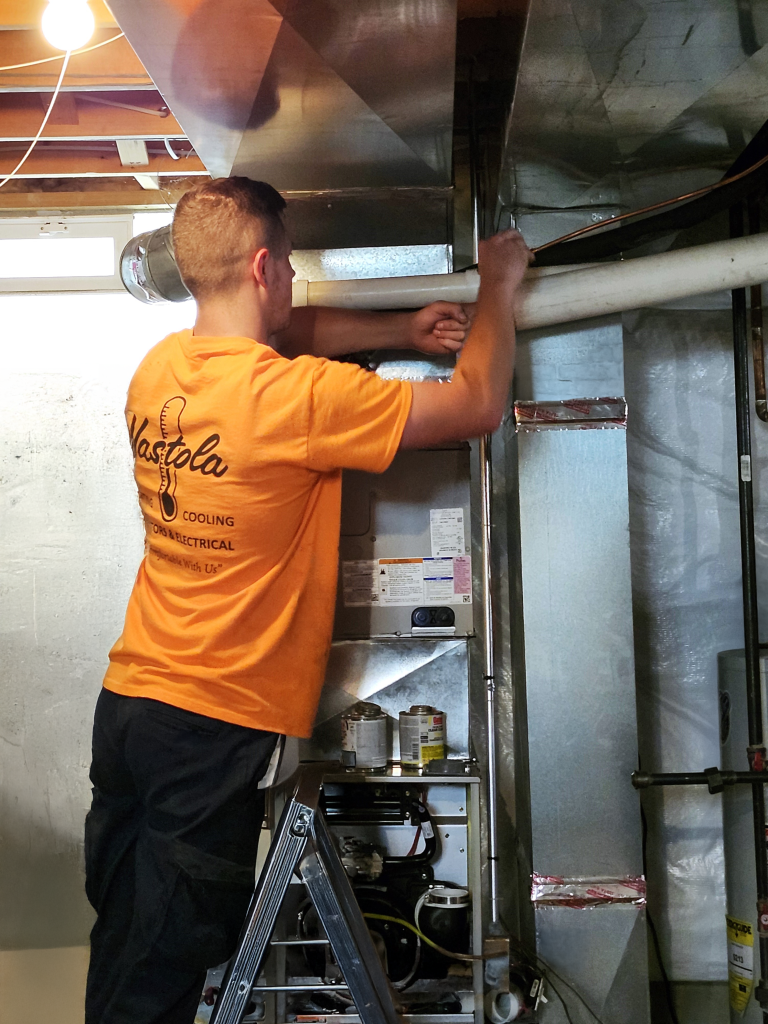


To change an AC filter, turn off the HVAC system, locate the filter compartment, note the filter size and airflow arrow, remove the dirty filter, and install a matching replacement with the arrow pointing toward the blower. Then close the panel, restore power, and record the replacement date. Learning how to change AC filter components correctly can support steady airflow, cleaner indoor air, reliable cooling, and better energy efficiency.
For Buffalo homeowners, filter care matters throughout the year. Air conditioning runs during warm, humid periods, while the same forced-air system may circulate heat through long winters. In addition, spring pollen, pet dander, renovation debris, and closed-window winter living can increase the material that reaches the filter. A clean filter helps air move more easily, although it cannot correct mechanical faults, damaged ducts, or improperly sized equipment.
Vastola Heating & Cooling helps homeowners throughout Buffalo and Western New York maintain comfortable, dependable homes. Because every property and HVAC system is different, the correct filter, airflow direction, and replacement schedule may vary. When a filter change does not restore comfort, our team can inspect the system and recommend practical service options. Homeowners can also explore our Buffalo air conditioning installation and replacement services when an older system no longer performs reliably. Vastola’s website states that the company provides installation, repair, maintenance, and 24/7 emergency support for Buffalo-area cooling systems.
1. Why Your AC Filter Matters
An AC filter sits in the return-air path of a central heating and cooling system. As the blower pulls indoor air toward the equipment, the filter captures dust, hair, lint, pollen, and other particles. Therefore, it helps protect internal HVAC components from excessive buildup. It may also reduce the particulate matter that recirculates through the home.
A clogged filter creates resistance. As a result, the blower may struggle to move enough air across the evaporator coil and through the ducts. Rooms may feel less comfortable, supply vents may deliver weaker airflow, and the system may run longer. ENERGY STAR advises homeowners to check filters monthly during heavy heating and cooling seasons and replace a filter when it looks dirty.
However, a new filter is not a complete repair strategy. It will not fix a failing capacitor, refrigerant issue, frozen coil, blocked drain, blower problem, or leaking duct. Filter replacement provides essential preventive care, but persistent cooling problems require proper diagnosis.
2. Before You Start: Identify the Correct Filter
Before changing the AC filter, confirm that the replacement matches your HVAC system’s requirements. The correct size, thickness, filter type, and MERV rating help maintain proper airflow and prevent dust from bypassing the filter. Use the table below to prepare before installation.
What to Check | What to Look For | Why It Matters | What to Do |
Filter size | Check the size printed on the filter edge, such as 16 x 20 x 1. | The wrong size can leave gaps or fail to fit. | Match all three dimensions exactly. |
Nominal size | The printed size may differ slightly from the actual size. | Measuring alone may lead to the wrong purchase. | Use the printed size whenever possible. |
Filter thickness | Check the last number, such as 1, 4, or 5 inches. | A thicker filter may not fit the cabinet. | Use the same thickness as the old filter. |
MERV rating | Look for the MERV number on the filter frame or package. | A higher rating may restrict airflow. | Choose a rating approved for your system. |
Filter type | Identify whether it is pleated, fiberglass, washable, or media style. | Different types have different airflow needs. | Replace it with the same approved type. |
Airflow arrow | Find the arrow printed on the filter frame. | The arrow shows the correct airflow direction. | Point it toward the blower or air handler. |
Filter compartment | Check for dust, damage, or bent tracks. | Gaps may allow dust to bypass the filter. | Clean loose dust and report any damage. |
Equipment label | Review the cabinet label or system manual. | It may list the correct filter details. | Follow the manufacturer’s instructions. |
New filter condition | Check for tears, bent edges, or moisture. | A damaged filter may not seal properly. | Use a clean and undamaged filter. |
Needed supplies | Prepare a flashlight, marker, phone, and trash bag. | These items make the task easier and cleaner. | Keep everything nearby before starting. |
Never force the filter into place. It should slide in easily and sit securely. If it looks loose, bent, or too large, confirm the correct size before restarting the system.
3. Step-by-Step Process for Replacing an AC Filter
Replacing an AC filter usually takes only a few minutes, yet correct installation matters. The five steps below work for many central air conditioners, furnaces, and ducted heat pumps. Because equipment layouts vary, review the owner’s manual and avoid sealed panels, wiring, refrigerant lines, or moving parts during this task.
- 1. Turn off the system. Set the thermostat to “off.” Then move the fan setting from “on” to “auto” if needed. When the filter sits beside the blower cabinet, you may also use the nearby service switch. Wait until the fan stops before opening the slot or return grille.
- 2. Locate the filter compartment. Look near the furnace or air handler where the large return duct enters the equipment. Some homes place the filter behind a large return-air grille in a hallway, wall, or ceiling. A zoned system may have more than one filter location, so check each designated return.
- 3. Remove and inspect the old filter. Slide it out slowly so loose dust does not fall into the cabinet. Note the dimensions, MERV rating, and airflow arrow. Compare the old filter with the replacement. The width, height, and thickness should match before you continue.
- 4. Install the replacement correctly. Find the arrow printed on the frame. Point it toward the blower, furnace, or air handler because air moves from the return area toward the equipment. Slide the filter in without bending it. The frame should sit straight and fill the slot without large gaps.
- 5. Close the compartment and restart the system. Replace the cover or secure the return grille. Restore the service switch, return the thermostat to cooling, and listen for normal operation. Finally, write the date on the filter frame or create a monthly phone reminder.
After installation, check several supply vents and listen for normal operation. Contact Vastola Heating & Cooling if airflow stays weak, cooling declines, or unusual sounds begin after completing the filter installation.
4. How to Confirm the Airflow Direction
The rule is simple: the arrow points toward the furnace, air handler, or blower cabinet. It never points toward the room. At an equipment slot, it usually points into the cabinet. Behind a wall or ceiling return grille, it usually points into the duct.
When unsure, hold a tissue near the closed return grille while the fan runs. The grille should pull it inward. Then turn the system off. Although many pleated filters have a support grid facing the blower, always follow the printed arrow.
Heating and Cooling Services Throughout Buffalo New York
Since 1946, Vastola has been a small family-owned business providing expert Heating, Cooling, Generator & Electrical Services throughout Erie, Niagara, Wyoming, Cattaraugus, and Chautauqua counties in Western New York.
5. Where AC Filters Are Commonly Located
Many Buffalo homes have a basement furnace with a filter rack between the return duct and cabinet. Other systems use a hinged media cabinet or place filters behind large hallway, wall, or ceiling return grilles.
Supply vents push air into rooms, while larger return grilles pull it back. Do not add filters to every grille unless the system requires them. If you cannot find the filter, follow the return duct toward the equipment, review the manual, or ask a technician to label the correct compartment.
6. When and How Often Should You Change the Filter?
There is no single schedule for every home. ENERGY STAR recommends checking filters every month, especially during heavy-use periods, and changing them when they appear dirty. At minimum, many common filters need attention at least every three months, although the manufacturer and system design should guide the final schedule.
A practical Buffalo plan starts with monthly inspection. During spring pollen, hot summer weather, major home projects, and the start of furnace season, inspect more often. Hold the filter near a bright light. If light barely passes through, or the media looks gray and loaded across most of its surface, replace it.
Consider these household-based starting points:
- Multiple pets: Inspect every two to four weeks and replace as needed.
- Allergy-sensitive occupants: Inspect monthly and confirm which filter rating the system can support.
- Large or active households: Check monthly because movement can stir up more dust.
- Renovation work: Check weekly during dusty work and replace the filter after cleanup.
- Low-occupancy homes: Inspect monthly during active heating or cooling, even when replacement occurs less often.
Thick media filters often last longer than one-inch filters because they provide more surface area. Still, thickness alone does not guarantee a lifespan. Follow product instructions, inspect the actual condition, and consider system runtime.
7. Signs the Filter May Need Early Replacement
Check the filter early when dust returns quickly, pet hair gathers near returns, airflow weakens, the system runs longer, or the frame looks gray and loaded. Whistling near the slot, a bending frame, uneven temperatures, and sudden dust buildup also deserve attention.
These signs do not prove the filter caused the problem. However, they justify an inspection. If a clean filter does not help, professional diagnostics can check the blower, coil, ducts, and humidity conditions.
8. Choosing the Right Filter: Basic Comparison
The best filter balances particle capture, airflow, equipment compatibility, price, and replacement frequency. Use the system manual first. Then consider the household’s needs and ask a qualified HVAC professional before moving to a much higher efficiency level.
Filter type | Main strengths | Possible limitations | Common application |
Fiberglass panel | Low initial cost and low resistance | Limited capture of smaller particles | Basic equipment protection where approved |
Pleated one-inch filter | Better particle capture and wide availability | Can clog quickly in dusty homes | Many standard residential systems |
Thick media filter | More surface area and longer potential service life | Requires a compatible cabinet | Homes designed for media filtration |
Washable filter | Reusable and reduces disposable waste | Must be cleaned and dried correctly | Systems that approve reusable filters |
Higher-efficiency filter | Captures finer particles when compatible | May restrict airflow in an unsuitable system | Air-quality goals with professional confirmation |
The EPA notes that all filters need periodic replacement or maintenance. It also advises homeowners to verify that higher-efficiency options suit the fan and filter slot. Therefore, do not choose by MERV number alone.
9. Common Mistakes to Avoid
Knowing how to change AC filter components correctly helps prevent airflow problems and dust bypass. Most errors are easy to avoid when you check the old frame, cabinet, and printed arrow before restarting the system.
- Reversing the airflow arrow: Point it toward the blower or equipment.
- Buying the wrong size: Match all three printed dimensions, including thickness.
- Forcing the filter: A bent frame can create gaps or collapse.
- Stacking disposable filters: Do not place two filters together unless the manufacturer requires it.
- Choosing a high MERV rating blindly: Confirm that the system can handle the added resistance.
- Leaving the slot open: Secure the cover so air cannot bypass the filter.
- Changing only one filter: Confirm whether the home has several returns or zones.
- Ignoring uneven dirt: Heavy buildup on one edge may indicate a poor fit or damaged rack.
Another mistake involves running the equipment without a filter “just for a day.” Even brief operation can pull dust toward the blower and coil. Instead, turn the system off until you have the correct replacement.
Air Conditioner Replacement
If your current AC unit is old, inefficient, or frequently malfunctioning, it might be time for a replacement. Our experts will evaluate your system and recommend the best replacement options for your home and budget.
Air Conditioner Installation
Whether you’re installing an AC unit for the first time or adding a new system to an existing structure, we’ll help you select the right unit and install it with precision and care.
Air Conditioner Maintenance
Regular maintenance is crucial for keeping your AC running smoothly and efficiently. We offer comprehensive maintenance plans to ensure your system stays in top condition while maintaining a good standing with your units’ warranty requirements.
Air Conditioner Repair
Is your AC not cooling as it should? Our skilled technicians can diagnose and repair any issues on any AC system, getting your system back to optimal performance quickly.
24/7 Emergency Service
We offer 24/7 Emergency Services for when you need us most.
10. What Does AC Filter Replacement Cost?
Filter prices depend on dimensions, thickness, efficiency, brand, package quantity, and cabinet type. Local retail prices also change. Therefore, use the following ranges only for planning, not as a product quote.
Filter category | Approximate cost per filter | Common replacement pattern | Main cost consideration |
Basic fiberglass | $3–$10 | Often monthly or as needed | Lowest upfront cost |
Pleated one-inch | $8–$25 | Commonly every 1–3 months | Balance of price and filtration |
Higher-rated pleated | $15–$40 | Based on loading and approval | Verify airflow compatibility |
Thick media filter | $30–$80+ | Often several months | Higher price but more surface area |
Reusable filter | $30–$100+ | Clean on an approved schedule | Requires careful washing and drying |
Do not choose a filter only because it costs more. A premium filter that restricts airflow may create comfort problems. Conversely, the cheapest option may not meet the household’s filtration goals. The correct filter fits the cabinet and supports designed airflow.
11. Maintenance Beyond the Filter
Filter replacement supports HVAC care, but it does not replace professional maintenance. A technician checks components that homeowners cannot safely or accurately evaluate, including electrical connections, blower operation, condensate drainage, thermostat function, coil condition, and cooling performance.
After learning how to change AC filter materials correctly, use this simple routine:
- Inspect the filter monthly. Replace it when dirty instead of waiting for a fixed date.
- Keep returns open. Move furniture, curtains, rugs, and boxes away from return grilles.
- Clean nearby areas. Vacuum loose dust around the cabinet without opening sealed panels.
- Watch for water. Request service when you notice staining, leaks, or drain backups.
- Clear the outdoor unit. Remove nearby leaves and debris without bending the fins.
- Schedule seasonal service. Arrange an AC inspection before sustained summer use when possible.
Vastola Heating & Cooling provides AC repair and maintenance service in Buffalo for systems that need more than routine filter care. The company services all AC makes and models and provides diagnostics, repair, and maintenance.
12. Expert Tips for Better Filter Performance
A consistent filter routine should stay simple and match the equipment. The following expert tips help Buffalo homeowners avoid airflow mistakes, remember inspections, and notice when rapid filter loading points to a larger concern. Pair these habits with the manufacturer’s directions and professional guidance for your HVAC system and household.
- Create a visual record. Photograph the filter label, airflow arrow, compartment, and installed position. Save the pictures in a phone album named “HVAC filter.” The record helps another household member buy the right size and install it correctly after the old filter has been discarded.
- Write the date on the frame. Mark the installation date on the cardboard edge. Then create a monthly inspection reminder. The written date shows how long the filter has served, while the reminder supports condition-based replacement instead of guesswork.
- Keep one replacement on hand. Buffalo weather can change quickly, and stores may not stock uncommon sizes. A spare lets you replace a dirty filter during a heat wave, winter storm, or holiday. Store it flat, dry, sealed, and away from chemicals.
- Inspect after dusty events. Check the filter after remodeling, drywall work, fireplace cleaning, basement projects, or long periods with open windows. Fine debris can load the media quickly. Replace it when buildup covers the surface, even if the filter is fairly new.
- Treat rapid clogging as a clue. A filter that becomes heavily loaded within days may point to unusual dust entry, construction debris, duct leakage, or excessive fan operation. Replace it, document the condition, and request an inspection if the pattern repeats.
Use these tips to make filter care easier and more reliable. Contact Vastola Heating & Cooling when recurring dust, weak airflow, or uneven comfort suggests a deeper HVAC issue at home.
13. How Filter Care Supports Indoor Air Quality
A central HVAC filter can reduce some airborne particles when the fan moves air through the system. However, no standard filter removes every pollutant. Cleaning, moisture control, source control, and ventilation also influence indoor air quality. The EPA explains that portable air cleaners and HVAC filters can reduce indoor air pollution but cannot remove every pollutant from a home.
Therefore, households with persistent dust, odors, allergy concerns, or humidity problems may need a broader solution. First, confirm the correct filter and replacement routine. Next, inspect for moisture, blocked returns, and visible dust sources. Finally, consider a professional indoor air quality evaluation.
Vastola provides indoor air quality services in New York and installs whole-house air purification systems that integrate with compatible HVAC equipment. These services may help households seeking more comprehensive particle control than a standard filter provides.
14. Keep Your Buffalo Home Comfortable With the Right HVAC Support
Knowing how to change AC filter parts gives homeowners a practical way to support airflow, equipment cleanliness, energy efficiency, and comfort. First, turn off the system. Next, match the filter size. Then confirm the arrow direction, install the replacement without gaps, close the compartment, and record the date. Inspect it monthly and replace it according to condition, household needs, system requirements, and manufacturer guidance. Still, routine changes cannot solve every cooling problem. If airflow remains weak, rooms stay uneven, the AC runs constantly, or the filter clogs unusually fast, the equipment may need professional diagnostics. Vastola Heating & Cooling can inspect the system, explain the findings, and recommend repair, maintenance, air quality, or replacement options based on your Buffalo home.
For dependable local support, review Vastola’s air conditioning installation and replacement services or schedule an HVAC evaluation before minor concerns become larger comfort problems. Contact Vastola Heating & Cooling today to keep your Buffalo home cool, efficient, and ready for the next change in weather.
Conclusion
Knowing how to change an AC filter is a simple but important part of home maintenance. A clean, correctly fitted filter helps support steady airflow, better indoor air quality, and reliable cooling during Buffalo’s warmer months. It can also reduce dust buildup inside the HVAC system and help the equipment operate more efficiently. Homeowners should check the filter regularly, confirm the correct size and MERV rating, and install it with the airflow arrow pointing toward the blower. A consistent replacement schedule based on pets, allergies, household activity, and seasonal use can help prevent avoidable comfort problems.
However, changing the filter cannot solve every air conditioning issue. If your system still has weak airflow, uneven temperatures, unusual noises, frequent cycling, or poor cooling after a filter replacement, professional service may be needed. Vastola Heating & Cooling provides dependable AC maintenance, repair, installation, and replacement services for homeowners throughout Buffalo, NY, and Western New York. Our experienced team can inspect your system, identify the cause of the problem, and recommend the right solution for your home. Contact Vastola Heating & Cooling today to schedule service and keep your home comfortable, efficient, and ready for Buffalo’s changing weather.